Lærdal · Late 12th century
Borgund
It is not the largest, but many find it the most impressive. Dark timber protected with tar, tiered roofs and a free-standing medieval bell tower make Borgund the archetypal stave church.
Plan your visit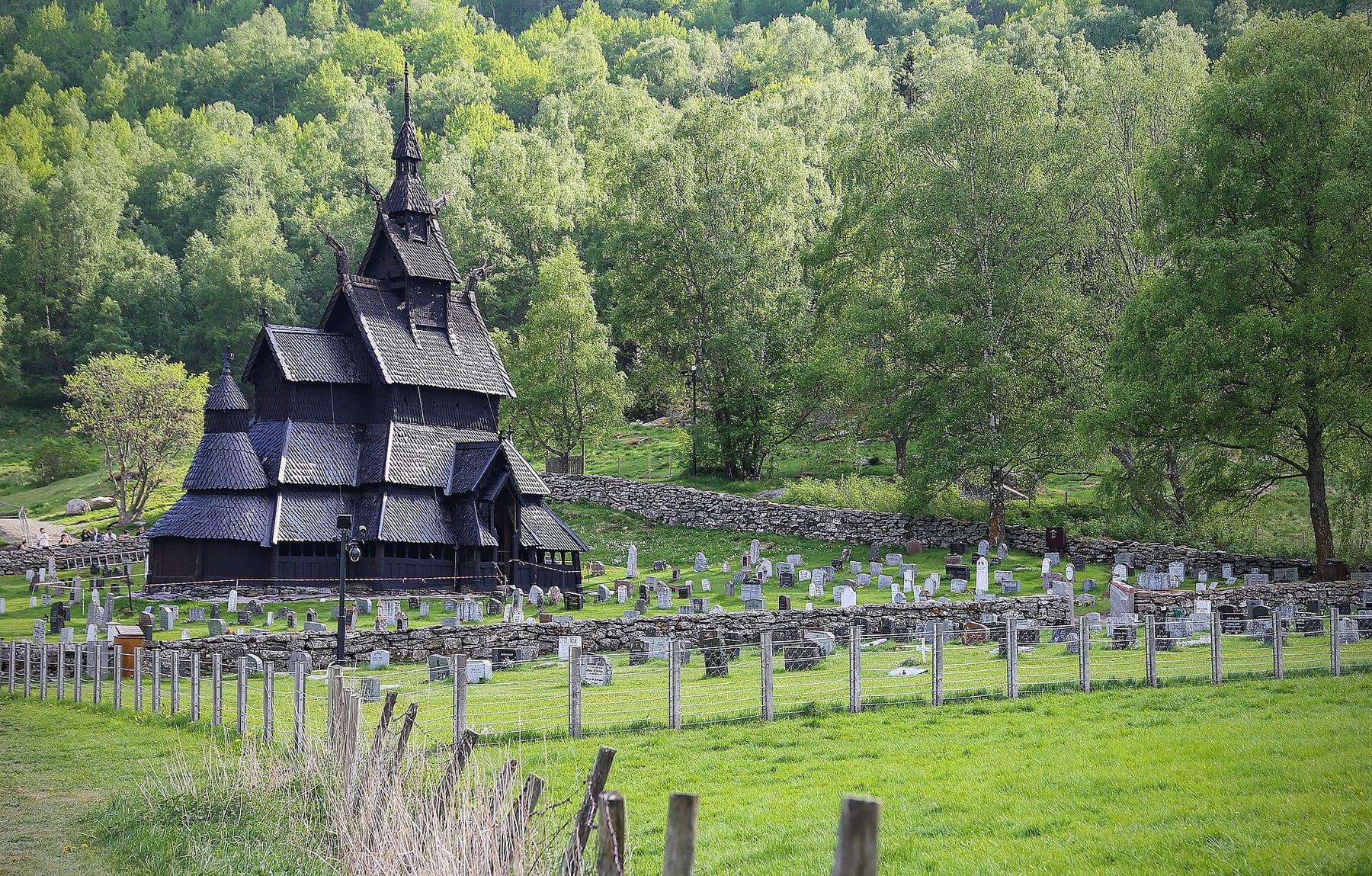
Chapter 04 · Culture & History
Among dragon heads, trading houses and old power stations, Southern Norway tells the stories of people who created something distinctive with the sea, mountains and scarce resources.
More than a backdrop
Fjords were transport routes, waterfalls became energy and timber became the material for churches, warehouses and entire neighbourhoods. Knowing these stories lets you see much more on your journey.
Trade, seafaring and the first royal seats.
Timber craftsmanship between ancient symbolism and Christianity.
Bergen becomes a hub of northern European trade.
Industrial towns transform valleys and society.
Norway's wooden Middle Ages
Stave churches feel both familiar and otherworldly. Their supporting posts, tiered roofs and carved portals combine medieval Christianity with motifs recalling the world of the sagas.
It is not the largest, but many find it the most impressive. Dark timber protected with tar, tiered roofs and a free-standing medieval bell tower make Borgund the archetypal stave church.
Plan your visitNorway's largest stave church rises above the valley like a wooden cathedral. Three towers, encircling galleries and the neighbouring open-air museum make it a rewarding cultural stop on a journey through Telemark.
Plan your visitSmall, dark and especially atmospheric. Combine the church with the Vest-Telemark Museum and the old farms on the hillside.
Find out moreBuilt around 1250, the church became one of Norway's most important medieval pilgrimage destinations because of its supposedly healing crucifix.
Find out moreVikings and early kingship
The Viking Age becomes easier to understand when you visit longhouses, burial mounds and old shipping routes. Power developed here not far from everyday life, but along the coast.
One of Norway's oldest royal seats stood beside the strategic Karmsund strait. The underground Nordvegen History Centre and reconstructed Viking farm tell of rulers and the lives of ordinary farmers.
Explore the Viking farmThe Midgard Viking Centre stands among imposing burial mounds. Its reconstructed great hall shows how political alliances, feasts and rituals contributed to the power of regional elites.
Plan your visitThe Hanseatic League and old port towns
Bergen · UNESCO World Heritage
Behind Bryggen's colourful façades, narrow passages lead between long rows of warehouses. For centuries, German merchants organised trade here in dried fish from the north and grain from Europe.
The district is not an unchanged medieval scene: fires repeatedly destroyed Bergen, and houses were rebuilt on the old plots. These layers are precisely what makes Bryggen fascinating. At Bryggens Museum, you can see archaeological finds and the foundations of the early town.
Bryggens MuseumStart at the medieval cathedral, then walk through Gamle Stavanger down to the harbour. Religious, civic and maritime history sit close together here.
The old timber-house district follows the regular street plan of 1641. Small houses, courtyards and quiet streets reveal another side of this southern Norwegian port city.
The view from Krantoppen in Risør and Lillesand's sheltered harbour offer two particularly beautiful versions of the white coastal town. Their façades tell of merchants, sailing ships and a time when harbours were the coast's economic heart.
Seafaring, exploration and beacons
Norway's relationship with the sea stretches from coastal trade to polar expeditions. Two very different places bring that history vividly to life.
You can board the original polar ship and discover the cramped, dark and technically ingenious conditions of expeditions led by Fridtjof Nansen, Otto Sverdrup and Roald Amundsen.
Easy to combine with Kon-Tiki and the Maritime Museum.Check opening hoursWhere the Skagerrak meets the North Sea, coastal history becomes a physical experience. Wind, surf, the lighthouse and exhibitions tell of navigation and the everyday lives of lighthouse families.
Especially impressive in stormy weather — keep a safe distance from the sea.Plan your visitHydropower and industry
Rjukan · UNESCO World Heritage
At the start of the 20th century, hydropower transformed remote valleys into modern industrial towns. Rjukan and Notodden tell not just of machinery, but of workers' housing, railways and a new way of life.
When it opened, Vemork was one of the world's most powerful hydroelectric stations. Today, the Norwegian Industrial Workers Museum explores its turbine hall, World Heritage history and the newly opened heavy-water cellar.
Visit VemorkThe company town, railway, ferry and factories together form an industrial cultural landscape.
UNESCO listingOn the Sørfjord, monumental power-station architecture and industrial history meet the mountains around Odda.
A power station, workers' settlement and 4,444 wooden steps tell a story of industry on an almost roadless fjord shore.
Occupation, resistance and remembrance
History deserves time
On 9 April 1940, Oscarsborg Fortress sank the German cruiser Blücher, delaying the advance on Oslo. Today, you can reach the island by ferry and explore its fortifications, museum and fjord at your own pace.
In Kristiansand, ARKIVET documents German occupation, resistance, imprisonment and collaboration in Agder. Part of the exhibition occupies the cellars where the Gestapo interrogated and tortured people.
Take your time with culture
Churches, museums and historic sites work best as planned parts of the route — not as leftovers between two viewpoints.
Stave churches and smaller open-air museums often have limited opening hours outside summer.
Ten minutes is not enough for Borgund or Heddal. Visitor centres, details and surroundings are part of the experience.
Many churches are active places of worship; flash, tripods and interior photography may be restricted.
Heddal pairs well with Rjukan, Avaldsnes with Stavanger or Haugesund, and Lindesnes with a south-coast drive.
Photos
The photos in this chapter come from Wikimedia Commons under free Creative Commons licences. Some images have been cropped and resized for the page layout.
Opening hours and events can vary seasonally. Check the linked official websites shortly before visiting.